Blog

Happiness is a bowl of snails in Saigon

Also published at https://www.cordonbleu.edu/news/online-learning-student-article-karina-penner/en

Chef and author Anthony Bourdain once said, “I do not believe in love at first sight. I think you can make a case for love at first smell. And the smells of Vietnam are unlike anything I’ve ever smelled before.” Anyone who has fallen in love with this country can agree this analysis is spot on, and its culinary rapport can be traced back to a singular, modest, and unifying ingredient.

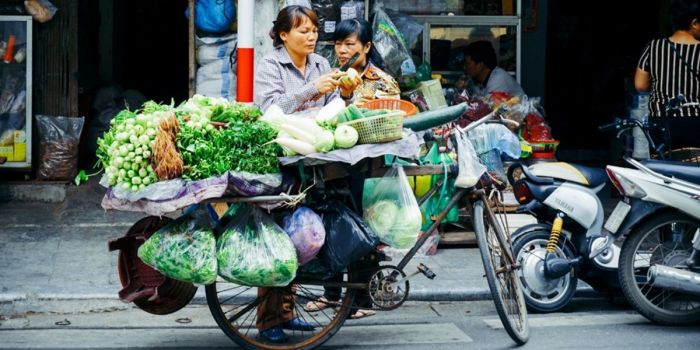
When you first turn the corner onto the famed Walking Street in Saigon, Vietnam, the smell may not be the first of the five senses that comes to mind. Passing the inept karaoke singers, flashing neon lights, and underage fire breathers, it is understandable that one could miss the petite woman frying an assortment of snails in a large wok on a small stand on a nondescript street corner. But, if you can find her, the sweet and sticky aroma of lemongrass and garlic will be the memory that lingers.

In November of 2019, I was lucky enough to have my own ‘a-ha’ moment enjoying this street-side delicacy myself. After shuffling along the country with a tour group for two weeks prior, frequenting restaurants that clearly catered to the Western American palette, I snuck off on my own in search of the real flavors of Saigon. Using the Google Translate app on my phone, I asked the woman with a kind smile on Walking Street to make me whatever she pleased. As I sat crouched on a sunflower pastel stool, slurping away at this foreign treat, I realized that my interaction with her, and this simple meal of snails in a Styrofoam container, was the dearest memory I would be taking home with me.

The consumption of snails in Vietnam has a long-standing history. According to Rice and Baguette: A History of Food in Vietnam, the Vietnamese people have been eating snails for thousands of years, long before the French took control of the country in the 1800s. Eating snails is considered a national past-time in Vietnam and an essential indoctrination into the eating and drinking culture of the country. Unlike the French, who have popularized escargot, or land snails, Vietnamese people enjoy what they refer to as Ôc, or sea snails. Aside from the massive difference in price tag as compared to the French, the culture surrounding these shelled gastropods are also miles apart.

While French escargot has gained a reputation of prestige and luxury, often costing more than 50 Euros for a plate of 12 delicately prepared crustaceans, the Vietnamese have a much more casual approach. Perched upon miniature plastic stools, chucking snail shells on the ground like peanuts at an American baseball game, drinking copious amounts of light, refreshing Hanoi or Saigon beer, this is how the Vietnamese relax and spend quality time with friends and family.

This concept of Nhâu, or eating and drinking together, exemplifies the Vietnamese peoples’ warm smiles, open arms, and tenacity to make something from anything. The sophistication and complexity of the seasonings and aromas used are on par with any high-end restaurant, but the Vietnamese culture of simply eating together is what sets these dishes apart in a spectacularly humble way.

It is estimated that in Saigon alone, there are well over 100 restaurants or food stands specializing in snails. In fact, in 2018, Duong Ba Trac Snail Street in Saigon was officially declared as a ‘food street’, a haven for both locals and tourists to come and try one of the countries most beloved dishes. Eaten chewy, slippery, meaty, or even crunchy, customers can choose from a variety of herbs, spices, and cooking techniques, providing endless combinations to jazz up otherwise somewhat bland ‘naked’ snails. Popular options include the common periwinkle snail, sweet snail, melo melo, and garlic snail. No matter which combination you decide to try, you will be met with a robust meal that somehow never leaves you feeling bloated.

Toasted ocean crab legs with chili and salt are also a welcome addition to the mixture, with the contrasting textures creating a playground for all of the senses. Joining forces with bitter morning glory, fragrant lemongrass, fresh green onions, buttery corn, and each unique vendor’s special sauces, is what gives every dish its own rare flavour experience. One of the most exciting things about engaging with this culinary treat is you can always discover something new.

Hearty, complex, and yet beautifully simple, enjoying snails the traditional Vietnamese way is something that anyone looking to engage with the true local culture must take advantage of. Although snails may not be the first thing you think to eat when visiting Vietnam, if the opportunity in your life comes to take perch on a low plastic stool, eat something new out of a bowl, and watch the world go by, it is highly recommended that you take it.

Weston’s Coolest Coffee Shop is Your New Neighbourhood Hangout

Also Published At: https://www.homeiscoliving.com/blog/westons-coolest-coffee-shop-is-your-new-neighbourhood-hangout

It is no secret that the Weston neighbourhood of Toronto is experiencing a resurgence. With the UP Express giving residents access to Pearson International Airport in 11 minutes and Union Station in the heart of downtown in 14 minutes, Weston is the perfect neighbourhood for those looking for quick access to downtown while experiencing the space and amenities of a more suburban area. With the addition of the state of the art facilities such as Artscape Weston Common and the second location of the popular Black Cat Espresso Bar, it is clear that Weston has increasingly more to offer. HOME sat down with Black Cat Espresso Bar Owner Justin to discuss why he feels Weston is one of Toronto’s best-kept secrets. 

What Is So Attractive About Weston?

Weston is one of the oldest business districts in Toronto. Justin, the owner of Black Cat Espresso Bar, had never ventured to the neighbourhood before looking for a space to call his businesses second home. He was automatically impressed by the history, redevelopment opportunities, and bones of the neighbourhood. Streets lined with towering blue spruce trees, historical homes, and tons of access to nature give Weston the charming neighbourhood vibe while still providing easy access to downtown, Pearson Airport, Artscape Weston, and much more. 

Justin looked at a lot of places before he decided to call Weston home. As he put it, “I kind of look at things from the point of view like developers and real estate people would, you look into the future, and I just saw the potential. A neighbourhood is always in one of three states. It’s either on the way up, leveled out or on the way down. That’s kind of the cycle. So I thought, ‘It’s got to be coming up’.” 

The development seen in the Weston neighbourhood is a sign of the times. The combination of the historical neighbourhood vibes with the addition of modern conveniences make Weston the ideal place to call home. A transit hub on both the UP Express and GO Transit, the introduction of modern infrastructure, and millennial-focused spaces such as Artscape Weston Commons, and West 22 are all indications that Weston is a neighbourhood on the rise. 

Bringing Community Together During Covid-19

Covid-19 has brought a lot of uncertainty for many business owners. Justin turned back to his musical roots during this time and decided that he was ready to facilitate a safe space that could bring families together. In addition to a secluded and quiet courtyard that is perfect for socially distanced coffees and gourmet sandwiches (the breakfast sandwich is next level and made fresh daily), Justin has also introduced some Covid friendly live music. His goal is to create a hub for the community to come together and enjoy themselves, which is different than his first location on College Street downtown. 

“Our first location on College Street, I didn’t have the desire to create a community. There are a million places where the community is left, right, and center. And [In Weston] I thought, people need somewhere to go, where it’s safe, where families can kick around here completely safe… there is definitely more of a hope for a community hub for this store than there was for the first store. And I think the neighbourhood really needs something like that.” Jazz, blues, folk, and other musical talents will be featured behind a transparent screen to provide a fun space for the neighbourhood to come together. “Bottom line, there were kids dancing, and families enjoying their life, which is not so easy to do these days”.

More Great Things To Come

With increasing development opportunities, public transportation, and new and exciting community hubs like Black Cat Espresso Bar, the Weston neighbourhood is showing no signs of slowing down. Next time you are in the area, grab a specialty coffee, pastry, or sandwich, snag a seat in the ultra-comfy sitting area equipped with lots of charging spaces and tons of plants and prepare to find your new favourite coffee shop in Weston. You can check out Black Cat Espresso Bar on Instagram and Facebook to get yourself in the mood for one of their mouthwatering offers and extra hip vibe, all at extremely reasonable prices. Starbucks who? 

What Happened to Survival?

Also published at: http://globalhobo.com.au/2017/08/04/what-happened-to-survival/

In December 2011, a volcano in Iceland erupted, halting air traffic all across North-Western Europe and displacing thousands of travellers just before Christmas. I was 16, travelling alone for the first time and desperately trying to make it from Rome to Canada before December 25th. The first thing I did when I got the news that I would indeed not be getting on my flight back home was pick up my cell phone and call my mom, crying harder to her than I had in years. Trudging along the Fiumicino airport, I set up camp outside McDonalds, the only place in the airport that Google told me was open 24 hours, and also had beer on tap.

Over the course of the next five days I spent my time trekking between various airline counters, booking flight sequences through Amsterdam, Germany, Turkey, Japan, anywhere that seemed it could provide me with the possibility that I could get even a step closer to home. For five days, I routinely checked my bags, passed through security, and waited at my airline’s gate only to see the inevitable CANCELLED in halting red letters on every screen. I even got to the point of desperation in which I attempted to bribe baggage attendants with Malboros to sneak me into the plane’s underbelly.

38 years earlier, in 1973, my uncle was desperately trying to make it from Saudi Arabia to Kenya to see his wife in time for Christmas. She had landed in Nairobi while he was grounded in London, due to both bad weather conditions and Muslim travellers on Pakistan Air being given priority seating during Ramadan. There were no phones, no email – simply no way to connect.

Fortunately, I come from a long line of hyper-organised women, so they had naturally come up with a plan months prior via handwritten letters, in case an unprecedented event like this occurred. Assuming that British Airways was one of the more reliable companies in the world, they had agreed to leave a message at their Nairobi airport counter detailing their new course of action should they need one. However, when my aunt arrived at the BA desk, she was greeted with a door to a broom closet, no employees to be found, and certainly no contact information.

So, after waiting in the airport for eight hours with no sign of him, my aunt did what any logical 20-year-old in the ’70s would do. She took a piece of scrap paper, wrote that she would be travelling across the Serengeti desert, and to use a payphone to call once he had reached the Kenyan border so that she could bribe the border crossing agents with candy bars. She then took a nail provided by a friendly maintenance man, and hammered this note to a telephone pole in the middle of the airport, next to hundreds of other notes from fellow travellers in the hopes that their loved ones could recognise the handwriting and find their calling card.

When stuck in unfamiliar territory, the first things we crave are the comforts of home. For my aunt, this meant the warm embrace of her loved ones. But within the past few decades something has changed. Home, to some, is now defined by the place where your Wi-Fi automatically connects. If I had gotten stuck with no forms of communications or technology, I seriously doubt that I would have the street smarts and savvy to get myself out of a hard situation. I can barely make it across my neighbourhood without the help of Google maps, let alone navigate the Serengeti!

The ways in which humans have pushed their boundaries and explored the unpredictable for centuries has now been taken over by the discovery of the New World, of technological communication. For the first time in history, it is actually debatable whether Christopher Columbus or Mark Zuckerberg can be deemed the furthest reaching explorer of all time. It seems that technology is hammering out the basic survival instincts that we as humans have relied on for all of history. Instead of “fight or flight”, millennials have “respond or mark as ‘unread’”.

We have stopped using our survival muscle because frankly, we don’t need to. Life for the majority of people living in the Western world has every comfort delivered to your front door, so the need to exercise our survival instincts disappears, and in turn so do those very intrinsic instincts that have been so crucial to human survival up until this point.

I finally landed back in Canada after 27 hours of travel and seven connections, and gratitude was the furthest thing from my mind. Annoyance, rage and desperation were certainly present at every stage of my journey, but never appreciation. Although every convenience had been made available to me in my time of despair, the act of patience had escaped me, and therefore made acknowledgement for all my resources impossible. I lacked the ability to use the values that should be so natural to me. I barely have the attention span to wait for a text back, let alone search for a handwritten note on a telephone pole.

This generation, my generation, would rather find love by conveniently swiping through hundreds of potential “matches” dictated through a computer program, rather than taking a risk on someone without being able to decipher their profile first. Spontaneity is rapidly disappearing.

After three days, my uncle was once again air-born, and flew from London through Rome and into Tanzania. He never even passed through the Nairobi airport in the end, and my aunt says there is a good chance that the note is still sitting on that pole, read by many but never who it was meant for. Their embrace at the Kenyan border was filled with emotion. “All of our struggles had been worth it to finally be back together, I was so grateful that we had found each other,” she tells me.

The primal instincts of survival helped them defy the odds that today would keep many of us stopped in our tracks, even with all of our available resources. So, the next time you may be delayed, impatient and feeling the tears well up in your eyes, remember that you are a part of a long history of humans who didn’t need the latest iPhone to triumphantly make it through this world.

Cover by Ilya Ilyukhin

Robot Hotels aren’t only in Japan

I arrived to the most German city in Austria, Graz, in the dead of night. Coming from Budapest, where the people wont sleep until they crash down on the sidewalk, it was a strange departure to see a main road completely isolated.

Groggily getting off my bus around 10:30pm, and unable to find a cab, I journey through one of the cities main streets, the Keplerstrabe, to find my hotel. As like every single shop, convenience store and bus station I have seen on my short walk through this city, it is completely empty and dark. Not even a receptionist to be seen. Instead, I am greeted by a slot on the door which tells me to insert my credit card for entry.

Skeptical, but with no other options, I slowly insert my card and the room comes to life. The doors automatically open, the lights flicker to brightness, and I am greeted by a computer monitor. After filling in my information on the high tech touch screen, another slot appears in which my room key is dispensed.

After getting slightly lost in the maze of rooms I drop my things down on the bed and go back outside for a cigarette. As I stand in the back alley with not a soul to be seen, I realize this might not be the safest idea, and head back to my room.

The next morning, still hungover from my stint in Budapest, I go downstairs to check out. Much to my surprise, still there are no staff members in the lobby. I can only imagine how low this place’s employment costs are! I wander into the street and make my way for the train station, where luckily I see some other actual humans.

3 young adults dressed in leather almost as shiny as their mohawks and piercings walk in front of me. As they pass by a poster advertising a political candidate, the girl of the group begins to kick it and spit on it. Passerby’s notice but go unfazed, as if they had seen this many times before and don’t expect it to stop anytime soon.

Maybe a world with fewer humans isn’t such a bad thing.

Riding the Russian Express

Also Published at: http://globalhobo.com.au/2017/10/09/riding-the-russian-express/

The smell of sausages and sweat permeates the air. Thousands of commuters push past me, an inconsequential outsider they have no problem squishing like a bug. I’m most likely the only tourist visiting the working-class suburbs of St. Petersburg, let alone hitching a ride. “Elbows up!” my aunt Tanya beckons as we push into the entrance of the metro station with an unsettling sense of urgency. A highly regarded professor of engineering at the University, she and 2.5 million other commuters take this trip daily, social status be damned.

Our tokens collected and deposited, we begin the 86-metre journey straight down the escalator to hell. The metro in St. Petersburg was first dreamed up in 1820, but took until 1955 to actually be put into action; bureaucracy at its finest, eh? In a country founded off hypocrisy, fear of the unknown and the dire need to protect the motherland, the metro is where the people of this city are at their most vulnerable. I am wildly uncomfortable already.

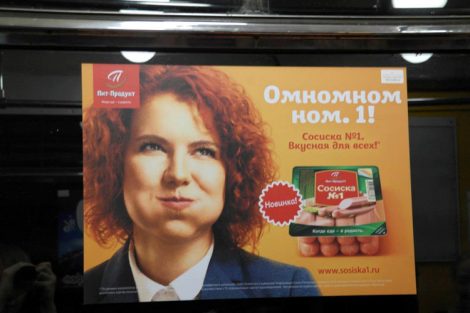
The natural light of the real world disappears, replaced with neon advertisements plastered to every inch of wall space. Everything here has been planned and executed with the mentality that sacrifice is not true sacrifice if in the name of ‘Mother Russia’. President Vladimir Putin’s new biography is most prevalently promoted, his face radiating through the fluorescent tubes. Beside him, a jolly looking ginger is displayed chowing down on more sausages: “Om nom nom”, the advertisement reads. Down still, deeper into an unknown which seems not to faze my fellow passengers. The smell of sausages gets stronger. How is that possible? Must be what they use to fuel the trains, I joke internally, feeling my naivety beginning to wear off.

My eyes are suddenly assaulted with the most impressive displays of intricacy. Each metro station here is equipped its own unique design and theme, a stark contrast to the conformist blobs of human traffic that run through them. White marble, gold leafing, futuristic neon lights, textured walls adorned with statues. The creativity does not cease below ground; it thrives. Like the past generations of oppressed rising from below, the metro is a creative playground buried underneath the authoritarian concrete above. Coming from a country that actually employed an ‘Agency of Censorship’ that lasted for centuries, these stations attempt to rewrite history.

Doors are open; it’s go time. Me and Aunt Tanya make eye contact as hundreds of people begin a battle to push their way onto a seat, no pleasantries involved. She tries to grab my hand, but my butter fingers slip through and I’m left to my own devices. Salmon swimming upstream, cattle being herded, Russians on their way to work. I have to stop myself from moo-ing. More wafts of sausages.

As the doors close, I watch a lady lose her lunch in order to save her fingertips. Aunt Tanya tells me that the doors on the train have no security sensors, so if you get caught as they’re closing, as many passengers often do, no one really gives a shit. Contrasting to metropolises like Tokyo, where passengers actually form single file queues to board the train, you must fend for yourself here, eat or be eaten. We pack closer and closer together, sardines in a can, much like what we feasted on the night prior.

The doors shut and the cut-off from fresh oxygen shifts the entire carriage. Decade-old wheels screeching, the station’s decadent marble façade in front of me vanishes into darkness within seconds. Suddenly, it is uncomfortably calm. What were once ferocious beasts clawing their way onto this metal box now instantaneously succumb to slumber. A magic spell that has somehow escaped my ears; I look to see the entire train with closed eyes, gently swaying back and forth to the sound of the scraping wheels on decrepit tracks. As soon as the commuters have achieved their goal of securing an oh-so-idolised spot on the train, the reality of the real world and their never-ending schedules sends them all into hibernation for the remainder of the trip.

The metro is where the average Russian citizen finds solace, a place free from worry and protected from the harshness of their individual realities. Where their bodies can automatically alert themselves that their stop is arriving, as if it’s inbred in them since the day they take their first steps. In a country that seems so far from normality, the people in front of me are in their most natural state, dozing off on the train. I am Jane Goodall in the forest of unpredictable creatures, so peaceful that it verges on eerie.

All sense of this absurd state of reality is gone and our stop is next. A small portion of the train softly opens their eyelids, and zombie-crawl to the doors where my aunt Tanya and I are waiting to escape. The train comes to a halt and the energy quickens inside everyone who is not still asleep. I am greeted by a Michelangelo-like mural on the opposing wall. Hand-painted figures an inch-tall pile on top of each other to create this monstrous piece of art, cathedral-worthy without question. The commuters don’t even glance at what has left me with my jaw hanging open. The mundaneness and madness of it all begins to infuriate me, but I stay quiet. Besides, working so hard for such little reward, the least I can do is let them enjoy their ride.

Even if it is cloaked in the cologne of sausages.